
Screw Steels and Surface Treatments: Nitriding, Chrome and Bimetallic
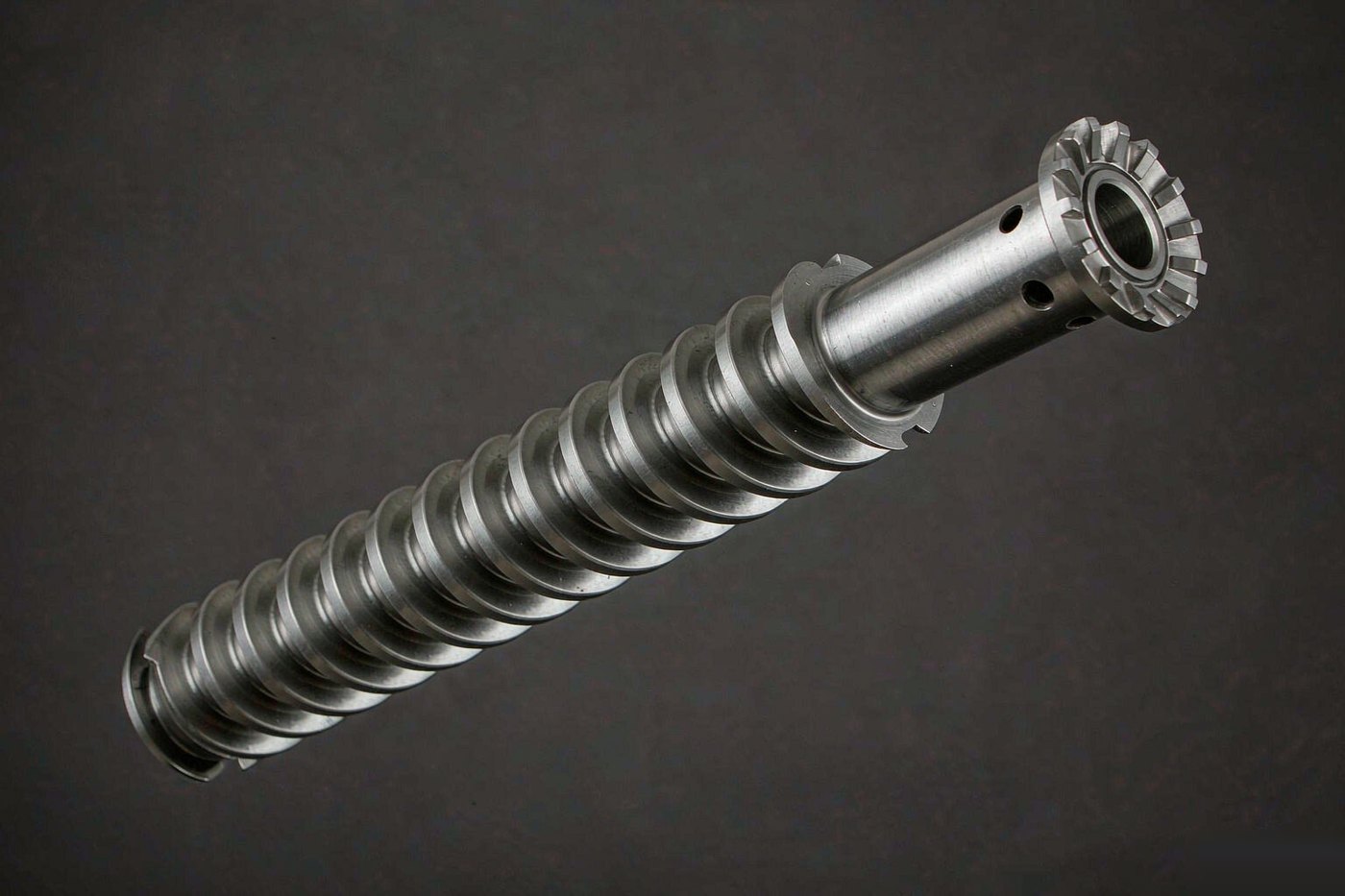
Choosing a screw involves two separate questions: which steel carries the load, and which surface treatment faces your resin. Many enquiries only ask "is it 38CrMoAlA" - the better question is how the surface matches the compound. Here is how the two layers work.
Base steel: strength and toughness
- 38CrMoAlA (JIS SACM645 equivalent): the standard nitriding steel for injection screws. Its aluminum content responds well to gas nitriding, and the tempered core keeps toughness under drive torque.
- 42CrMo: a high-strength alloy used as base for screws that receive overlay or plating, where the core must support the coating.
- Whichever the base, core hardness after tempering and finished straightness matter as much as the surface - a hard skin on a soft or bent screw delivers neither life nor quality.
Base steel is normally the processor's choice, tied to the treatment route. The option you can directly specify is the surface.
Four treatments
| Treatment | Typical hardness band | Strength | Typical resins |
|---|---|---|---|
| Gas nitriding | HRC 56-58 band, case depth 0.3-0.6 mm class | Economical, low distortion, re-nitridable | Unfilled PP, PE, PS, ABS |
| Hard chrome | Thin, hard, bright layer | Corrosion and release | PVC and corrosive compounds; low filler where release matters |
| Bimetallic overlay | HRC 60+ band | Abrasion against hard fillers | Glass and mineral filled compounds |
| Tungsten carbide | Highest of the options | Extreme abrasion duty | Highly filled engineering resins, long runs |
Hardness figures are common industry ranges; the values that apply to your order are confirmed on coupons and in the written specification - process control differences between shops show up directly in service life.
Matching by resin
- Commodity resins: nitriding, economical and sufficient; wear is ordinary life, monitored through clearance trends.
- PVC and flame-retardant compounds: corrosion leads; hard chrome or a corrosion-conscious overlay, with geometry that avoids stagnation (see our PVC screw design article).
- Glass and mineral fillers: abrasion leads; bimetallic overlay as the baseline, carbide for long continuous runs.
- Unfilled PC and PA: nitriding suffices; keep zone temperatures honest, since an overheated surface layer accelerates wear.
- High-temperature filled grades (PC+GF, LCP): dual duty - high temperature plus abrasion - stated part by part in the written specification.
Always decide as a pair
A surface choice includes the mating part. An overlaid screw running in a nitrided barrel simply moves the wear to the barrel. Check the barrel's condition and construction before upgrading either component - our barrel pages cover the matching constructions.
Checking a supplier's treatment quality
- Nitriding: ask how case depth and hardness are verified (same-batch coupon or per-part), and ask for the record.
- Overlay: alloy grade and thickness, and whether ultrasonic bonding checks are available.
- Chrome: thickness and adhesion test method.
- Everything: a written specification naming treated areas, target hardness band and the inspection basis.
Centron states the base steel and treatment in the written specification, inspects against drawing before dispatch and ships the inspection record with the batch. Send us your resin and filler details and we will reply with the treatment choice and the reasoning.
相关产品
Unsure which treatment fits your compound? Send the resin and filler loading and we will reply with the specification we would use.