
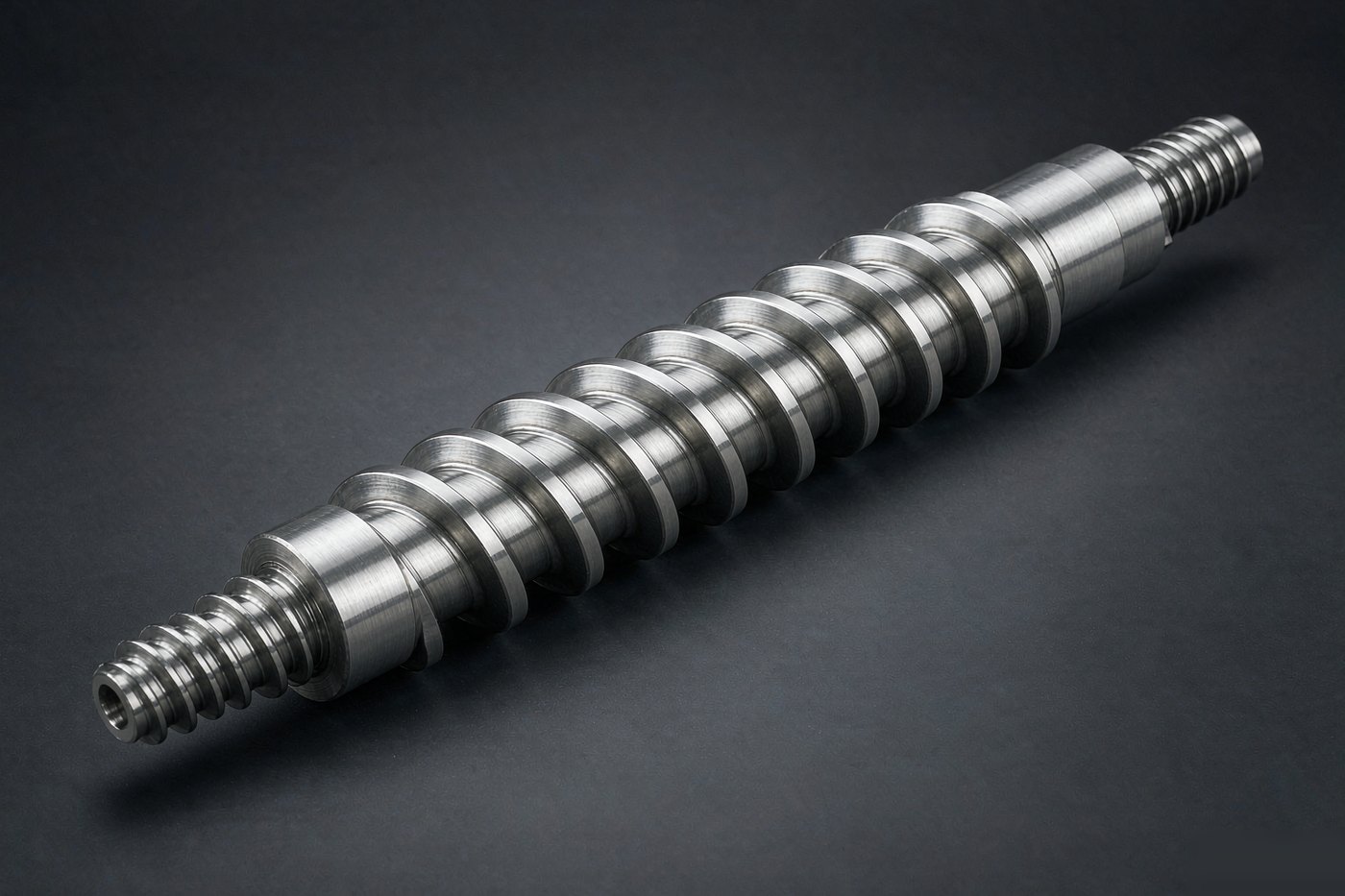
General Purpose Screw for PP, PE and ABS
Three-zone screw for commodity and engineering resins where steady output matters more than dispersion.
View details
Injection and extrusion screws in nitrided, bimetallic and hard-chrome finishes, cut to your barrel dimensions and screw geometry rather than to a catalogue number.
Machined to your barrel dimensions and screw geometry — no catalogue constraints. Single replacement part or production batch.
Engineering review Monday to Saturday. Send the machine model, screw diameter and resin — the reply carries price, material grade and lead time.
No drawing on file? Send a photo of the worn part and the machine model — we work the geometry back and confirm it with you before machining.
The screw is where the shot is made. Feed depth, compression ratio, flight pitch and the length of each zone decide whether a resin melts evenly or arrives at the nozzle with unmelted cores and a temperature spread that shows up as flash on one part and a short shot on the next.
We cut screws to the barrel you already have. That means the starting point is your drawing or your existing screw, not a catalogue number — although the standard geometries below cover most of what comes through the door.
| Zone | Job | Typical share of L/D |
|---|---|---|
| Feed | Conveys solid resin and starts to compact it | About 25–30 %, deeper channel than the rest of the screw |
| Compression | Melts and compresses; the channel shallows out here | About 20–25 %, depth ratio set by the compression ratio |
| Metering | Pumps a uniform melt at stable pressure | About 45–50 %, shallowest and most tightly toleranced section |
The shares move with the resin. A crystalline material such as PA or POM usually wants a longer compression zone than an amorphous PS or ABS; a vented screw needs a decompression zone between the two stages and cannot be laid out as a simple three-zone profile.
| Type | What it does | Where it earns its cost |
|---|---|---|
| General purpose | Conventional three-zone, single flight | Commodity PP, PE, ABS, PS; short cycles where mixing is not critical |
| Barrier | A secondary flight separates solid from melt along the melting length | High output, thick sections, resins that need a fully melted stream |
| Mixing section | Adds pins, a Maddock or a slotted mixer at the metering end | Color and additive dispersion, masterbatch, regrind blends |
| Vented | Two stages with a decompression zone under a vent port | Hygroscopic resins and regrind that carry moisture or volatiles |
| Treatment | Hardness band | Choose it when |
|---|---|---|
| Nitrided, 38CrMoAlA | Surface hardness in the HRC 56–58 band | Unfilled commodity resins; the economical default |
| Bimetallic overlay | Overlay hardness in the HRC 60+ band | Glass or mineral filled compounds, high filler loadings |
| Hard chrome | Thin plated layer over a hardened base | Corrosive resins and PVC processing, where release matters |
| Tungsten carbide | Highest wear resistance of the options | Abrasive filled engineering resins, long uninterrupted runs |
Hardness bands and zone shares above are the customary ranges for these constructions. The figures on your order are confirmed against your drawing or sample before cutting, not taken from this page.
Three-zone screw for commodity and engineering resins where steady output matters more than dispersion.
View details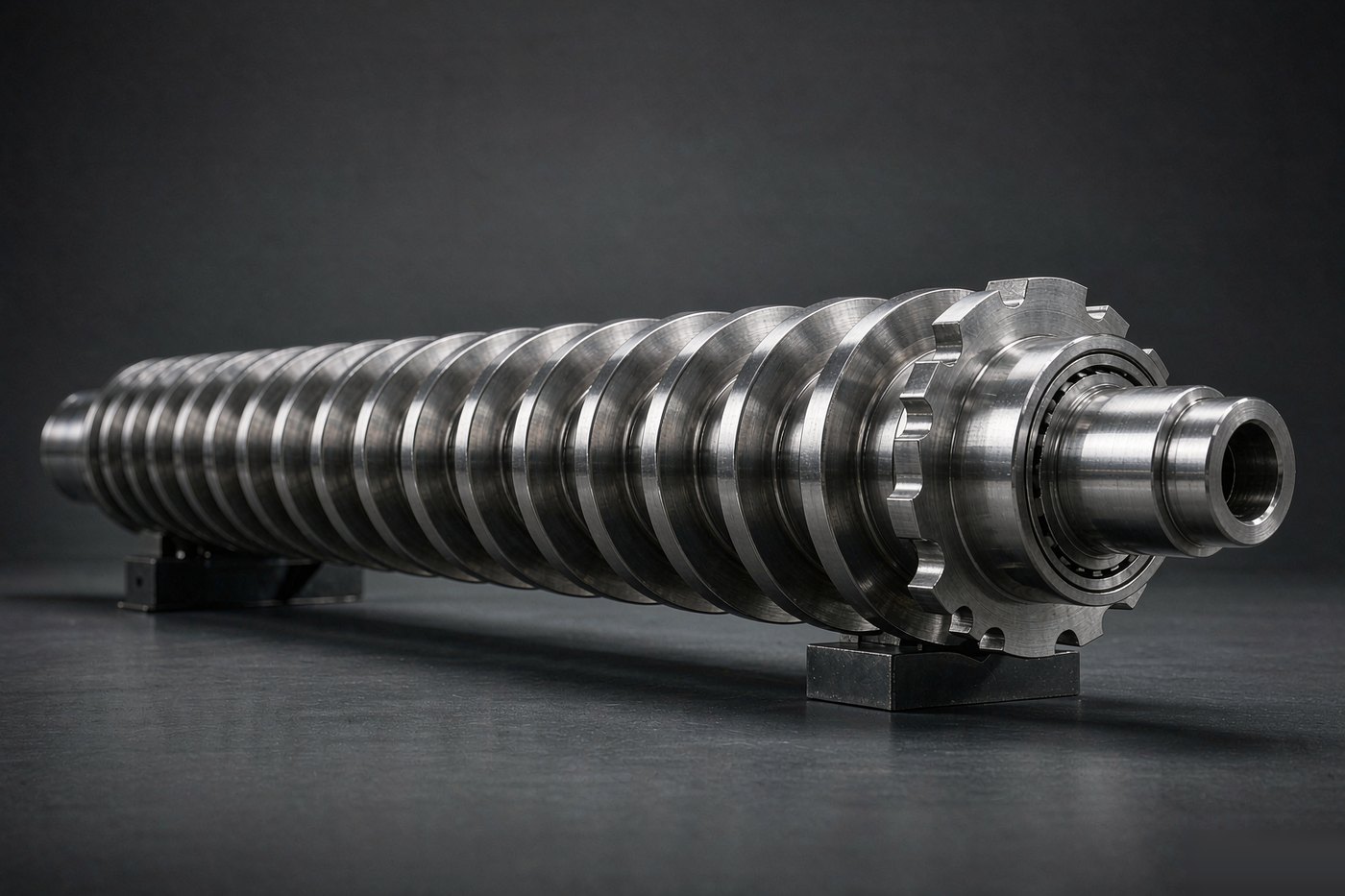
Separates solids from melt for a more even melt temperature on large shots and narrow processing windows.
View details
Injection and extrusion screws in nitrided, bimetallic and hard-chrome finishes, cut to your barrel dimensions and screw geometry rather than to a catalogue number.
View detailsSend the machine model and the resin. We confirm geometry, material and surface treatment before quoting.
Have a drawing? Reply to our confirmation email with the file attached — PDF, STEP, DXF or a photo of the part all work.
Our engineering team answers during working hours, Monday to Saturday. For urgent orders, call +8613751260808.